
Guide
How to Use a Tumble / Rotisserie Basket
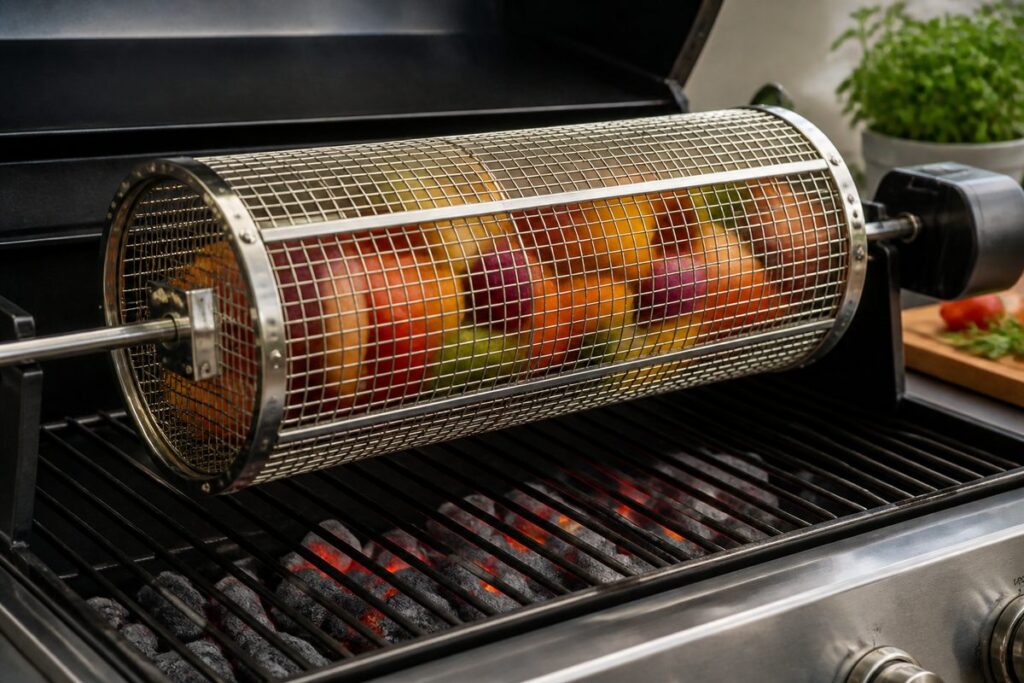
A tumble basket — sometimes called a rotisserie cage, flat rack or wheel — turns your rotisserie into a hands-off machine for small, awkward foods that won’t sit on a spit. It’s a perforated cage that clamps onto the rotisserie rod and rotates, so wings, chunks of vegetable, potatoes, nuts and cubed meat constantly tumble through the heat. Nothing sits still long enough to scorch, everything self-bastes in its own rendered fat, and you get even browning all over with almost no stirring. Here’s how to load, run and clean one for the best results.
How a tumble basket works
On a normal grill, small items need constant turning or they burn on the bottom and steam on top. A tumble basket solves that mechanically: as the rod spins, the cage lifts food up and lets it fall, so every piece passes through the hottest zone again and again. That motion does two useful things. It exposes every surface to even heat for uniform colour, and it keeps tossing the food through its own dripping fat and juices, which bastes and crisps the exterior. The result is wings and roast vegetables that come out evenly bronzed and crunchy without you touching them.
Don’t overfill — load it right
The single most important rule is to leave room for the food to actually tumble. Fill the basket no more than about half to two-thirds. Pack it full and the food jams solid, the cage just rotates as a block, and you lose the entire benefit — the pieces against the bars char while the ones in the middle steam. Cut items to a roughly even size so they cook at the same rate, and group foods with similar cooking times together. Make sure the cage latch is fully closed and secured before you mount it, and check the rod is balanced so the motor isn’t straining against a heavy side.
Use indirect heat
Run the basket over indirect or dedicated rotisserie heat rather than directly over roaring burners. Tumbling food still has rendered fat dripping from it, and fat hitting open flame means flare-ups that blacken the outside before the inside is done. With a rotisserie burner at the back, or coals and lit burners banked to the sides with the basket spinning over a clear middle, the food roasts in radiant and convected heat. That gives you the deep, even browning you want without the acrid, sooty taste of a grease fire. Keep the lid down as much as possible to hold a steady roasting temperature. For more on the technique, see our rotisserie guide.
Best foods for a tumble basket
The basket shines with anything small, round or chunky:
- Chicken wings and drumettes — the constant tumbling renders the fat and crisps the skin all over.
- Potatoes — par-boiled and tossed in oil and seasoning, they come out fluffy inside, crunchy outside.
- Root and firm vegetables — carrots, cauliflower, Brussels sprouts, onions, capsicum.
- Nuts — for evenly toasted, smoke-kissed bar snacks.
- Cubed meat and sausage chunks — kebab-style pieces that would otherwise need skewering and turning.
Foods that are too soft or that fall apart easily — flaky fish, very ripe tomatoes — don’t suit the tumbling action and will turn to mush.
Seasoning and timing
Toss food in a little oil before loading so seasoning sticks and browning is even; oil also helps a dry rub adhere through all the tumbling. Go easy on sugary glazes early on, as sugar burns over a long spin — brush them on in the last few minutes instead. Because the basket browns the outside efficiently, don’t judge doneness by colour alone. Pull a piece and check it, and for anything where food safety matters, like chicken, verify the internal temperature with a probe thermometer rather than guessing from the crust.
Cleaning and care
Rendered fat and sticky glaze bake onto the bars, so clean the basket while it’s still warm when residue lifts more easily. Let it cool enough to handle, then soak it in hot soapy water to loosen the grease before scrubbing the mesh and corners with a stiff brush. Dry it thoroughly before storing — Singapore’s humidity will rust a damp basket quickly, especially a chrome-plated one. A quick wipe with oil before storage helps protect the finish.
Common mistakes to avoid
- Overfilling so nothing tumbles — the most common and most damaging error.
- Direct high heat causing fat flare-ups and a sooty, bitter exterior.
- Mixing cut sizes so some pieces burn while others stay raw.
- Glazing too early and ending up with burnt, bitter sugar.
- An unbalanced or unlatched cage that strains the motor or pops open mid-cook.
FAQ
Best foods for a tumble basket? Wings, potatoes, nuts and firm vegetables are the classics — anything small and chunky that benefits from constant motion and self-basting.
How full should I load it? No more than about half to two-thirds, so the food can actually tumble. A packed basket just rotates as a solid block and cooks unevenly.
Can I use it on a gas grill without a rotisserie? No — the basket needs a rotisserie motor and rod to turn. You’ll need a rotisserie kit compatible with your grill.
Why is my food burning on one side? Usually overfilling or direct heat. Reduce the load and move the basket over indirect or rotisserie burners.
See our grills & accessories or request a quote.